Toilet paper is not typically considered a health product. It sits alongside the soap and hand lotion, used automatically, replaced without thought. For most people, the only criterion is whether it does its job without falling apart.
But for a growing number of people, particularly women, the toilet paper they use is a persistent source of irritation. UTIs that recur without obvious cause. Vulvar discomfort that comes and goes. Skin sensitivity that worsens over time. Often, the roll on the holder is a contributing factor that never gets considered.
Why Toilet Paper Affects Women's Health Differently
The anatomy is relevant here. Women wipe front to back, but the tissue in contact during that process includes the vulva, the vaginal opening, and the perianal area. These are among the most sensitive, most permeable skin surfaces on the body. They are not designed to be a barrier against chemical absorption. They are the opposite.
Conventional toilet paper is processed with a range of compounds that were never designed with intimate skin contact in mind. They were designed to produce white, soft, durable paper at scale, and the chemistry involved reflects those priorities, not yours.
What's in Conventional Toilet Paper That Shouldn't Be
PFAS. A 2023 University of Florida study found PFAS compounds, synthetic "forever chemicals" linked to cancer, hormonal disruption, and reproductive harm, in 21 major brands across four continents. The skin in intimate contact with toilet paper is highly absorptive. PFAS exposure through this route is not theoretical.
Elemental chlorine bleach. The process that makes toilet paper bright white produces dioxins as a byproduct, among the most studied toxic compounds in existence, linked to immune suppression and reproductive damage. Dioxin residue on tissue that contacts vaginal and vulvar skin is not a negligible concern.
Synthetic fragrances. The "fresh" scent in scented toilet paper is a cocktail of synthetic compounds that serve no hygienic function. They are a well-documented cause of contact dermatitis, vulvar irritation, and disruption of the natural vaginal microbiome. Gynecologists have been recommending fragrance-free toilet paper for decades. The industry has largely ignored this.
Formaldehyde. Used in some products as a wet-strength agent, formaldehyde is a classified carcinogen that can cause skin irritation, sensitization, and with repeated exposure, more serious effects.
Dyes. Colored or patterned toilet paper adds aesthetic variety and nothing else. The dyes used are unnecessary irritants for sensitive skin.
The common thread: none of these additives need to be there. They are manufacturing choices, not functional requirements.

Why Bamboo Is the Right Material
Bamboo fiber is naturally smooth. Unlike wood pulp, which requires significant chemical processing to achieve softness, bamboo's fiber structure produces a naturally gentle texture. It doesn't need fragrances added to seem clean. It doesn't need harsh bleaching to appear white. The material itself is appropriate for sensitive skin in a way that conventionally processed wood pulp simply isn't.
Bamboo is also naturally free of the PFAS contamination that enters conventional toilet paper through wood-pulp processing at industrial paper mills. A quality bamboo toilet paper, one that's processed carefully and without shortcuts, arrives at your bathroom inherently cleaner than its conventional counterpart.
What to Look For
When choosing toilet paper for sensitive skin, the checklist is simple:
- 100% bamboo, FSC-certified
- Lab-tested PFAS-free, not just claimed
- Elemental chlorine-free processing
- Fragrance-free
- No dyes or added colorants
- 3-ply for genuine softness without roughness
One thing that list doesn't include: price as a primary criterion. Toilet paper is used multiple times daily, every day of your life. It is in direct contact with some of the most sensitive tissue on your body. The few dollars' difference between a product that meets these standards and one that doesn't is, by any reasonable measure, the most worthwhile spend in your household.
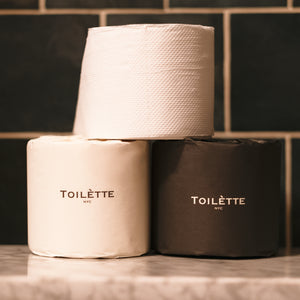
Toilètte Was Designed for This
We built Toilètte with intimate skin contact as the primary design constraint. Not just sustainability. Not just aesthetics, though we care about both. The first question we asked was: what should a product that touches the most sensitive parts of your body every day actually be made of?
The answer: 100% FSC-certified bamboo. Lab-tested, certified free of PFAS, formaldehyde, and elemental chlorine. Fragrance-free. No dyes. 370 sheets of premium 3-ply, individually wrapped, delivered to your door.
No compromises. No hidden ingredients. Nothing that shouldn't be there.