Most people never wonder what's in their toilet paper. It's white, it's soft, it does its job. It gets flushed. End of story.
Except it isn't. Because what's in that roll, and what it's touching, matters considerably more than we've been led to believe.
What PFAS Are, and Why They're in Toilet Paper
PFAS stands for per- and polyfluoroalkyl substances. There are over 12,000 known compounds in this family, all sharing one defining characteristic: an exceptionally strong carbon-fluorine bond that resists breaking down. In nature. In water treatment. In your body. Which is why they're known as "forever chemicals."
They were introduced into paper manufacturing not as an intentional ingredient but as a byproduct of the pulp process. Paper mills use PFAS-containing compounds during the wood-to-pulp conversion, and those compounds carry through into the finished product. A 2023 study from the University of Florida, published in Environmental Science & Technology Letters, tested 21 major toilet paper brands sourced from North America, Europe, Africa, and Central and South America. Every single one contained PFAS compounds.
The primary compound detected was 6:2 fluorotelomer phosphate diester, or 6:2 diPAP, which made up 91% of total PFAS found in the samples. This compound doesn't stay stable. Over time, it converts into smaller, more persistent PFAS including PFOA, which the EPA has classified as a potential carcinogen.
What PFAS Exposure Actually Does
The research on PFAS health effects has grown substantially over the past decade. The EPA's current findings link PFAS exposure to:
- Decreased fertility in both men and women
- Increased risk of certain cancers, including kidney and testicular
- Developmental delays and low birthweight in children
- Hypertension during pregnancy
- Hormonal irregularities
- Elevated cholesterol
- Reduced vaccine efficacy due to immune system suppression
These are not fringe findings. They come from peer-reviewed studies, the EPA, and researchers at institutions including Harvard's T.H. Chan School of Public Health.
The relevant point for toilet paper specifically: the skin in your perianal area is among the most permeable on your body. It is not a barrier to chemical absorption. It facilitates it. Using a product that contains PFAS compounds on that tissue, multiple times a day, every day, is not a trivial exposure route.
It's Not Just PFAS
PFAS aren't the only concern in conventional toilet paper. The bleaching process used by most major brands introduces its own set of issues.
Elemental chlorine bleaching, still widely used, produces dioxins as a byproduct. Dioxins are among the most toxic compounds ever studied, linked to reproductive damage, immune suppression, and cancer. They persist in tissue and accumulate over time.
Many brands also add fragrances. These synthetic compounds serve no hygienic function. They are present purely for perception, a "fresh" scent that signals cleanliness but delivers nothing of the kind. For people with sensitive skin, vulvar tissue, or a history of UTIs, fragranced toilet paper is a well-documented irritant.
Formaldehyde, used in some products as a wet-strength agent, has been classified as a carcinogen by the International Agency for Research on Cancer.
The picture that emerges is of a product category that has never been held to meaningful health standards because, for most of its commercial history, no one asked.
What Makes a Toilet Paper Actually Safe
The good news is that the standard is not complicated. A genuinely clean toilet paper is:
PFAS-free, verified by lab testing. Not just claimed. Tested by an independent laboratory and certified accordingly. This is the only meaningful distinction between "we say it's PFAS-free" and "we can prove it."
Elemental chlorine-free. ECF bleaching produces pulp without the dioxin byproducts of conventional chlorine bleaching. Modern ECF processes are considered by the Alliance for Environmental Technology to produce similar or lower environmental impact than even totally chlorine-free alternatives, while achieving the softness and whiteness that make a quality product.
Fragrance-free. There is no functional reason for fragrance in toilet paper. Its absence is simply the correct default.
Formaldehyde-free. Wet strength can be achieved through fiber selection and processing. Formaldehyde is unnecessary.
Bamboo toilet paper, when made properly, meets all of these standards naturally. Bamboo fibers don't require the same chemical treatment as wood pulp. They're naturally smoother, requiring less processing to achieve softness. And because bamboo isn't processed through the same paper mill systems as conventional wood pulp, it isn't contaminated with PFAS at the source.

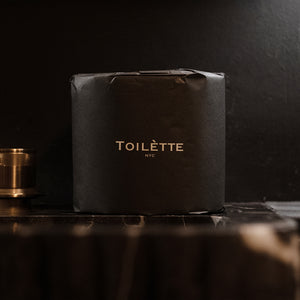
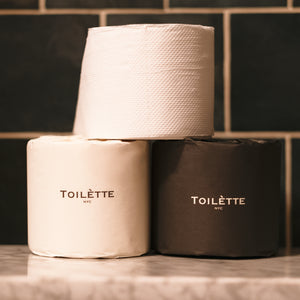
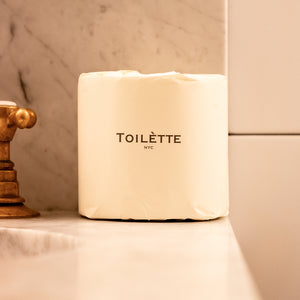
Why Toilètte Was Built Around This
When we developed Toilètte, PFAS-free wasn't a marketing decision. It was the baseline. The product we wanted to make was one that could be used with genuine confidence: on sensitive skin, for intimate hygiene, by people who are paying attention to what they bring into their homes.
Toilètte rolls are lab-tested and independently verified to be free of PFAS, formaldehyde, and elemental chlorine. FSC-certified bamboo. No fragrances. No compromises.
Because the product that touches your body most, most often, should be the one you think about most carefully.